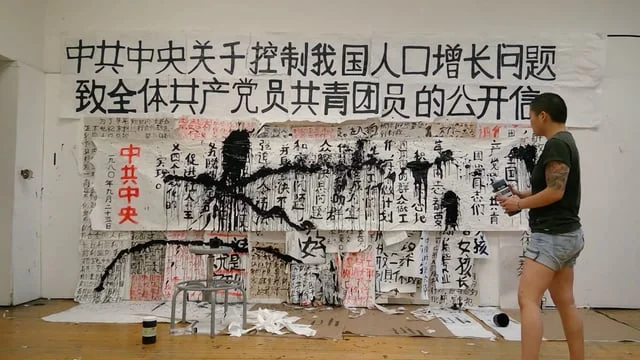
Although I wasn't trying to make the mural "How I Feel About the One-Child Policy" (see next image in gallery) a performance art piece, looking back I feel as though it could've been one. In fact it very well may have been a stronger piece if it had been. This video records the most cathartic moment of this mural project.
It's a statement about my feelings and opinions towards Communist China, and the one-child policy. The piece itself is a form of historical intervention, where I, a Chinese/adopted/girl, am able to explore contemporary Chinese art and culture and use it to express my relationship with a country that had no space for girls like me. The piece is meant to scream, I'm here, I exist, and bring attention to the power of words to completely change the course of history.
Reviewing this document I can't help but wish I could just do it all again. The act of defacing a project that took hours and hours to create felt so empowering and bad ass. Part of me wants to revisit this project as a performance piece, where viewers can come into the studio and watch me construct the wall once again, start to finish, ending with the paint splattering.
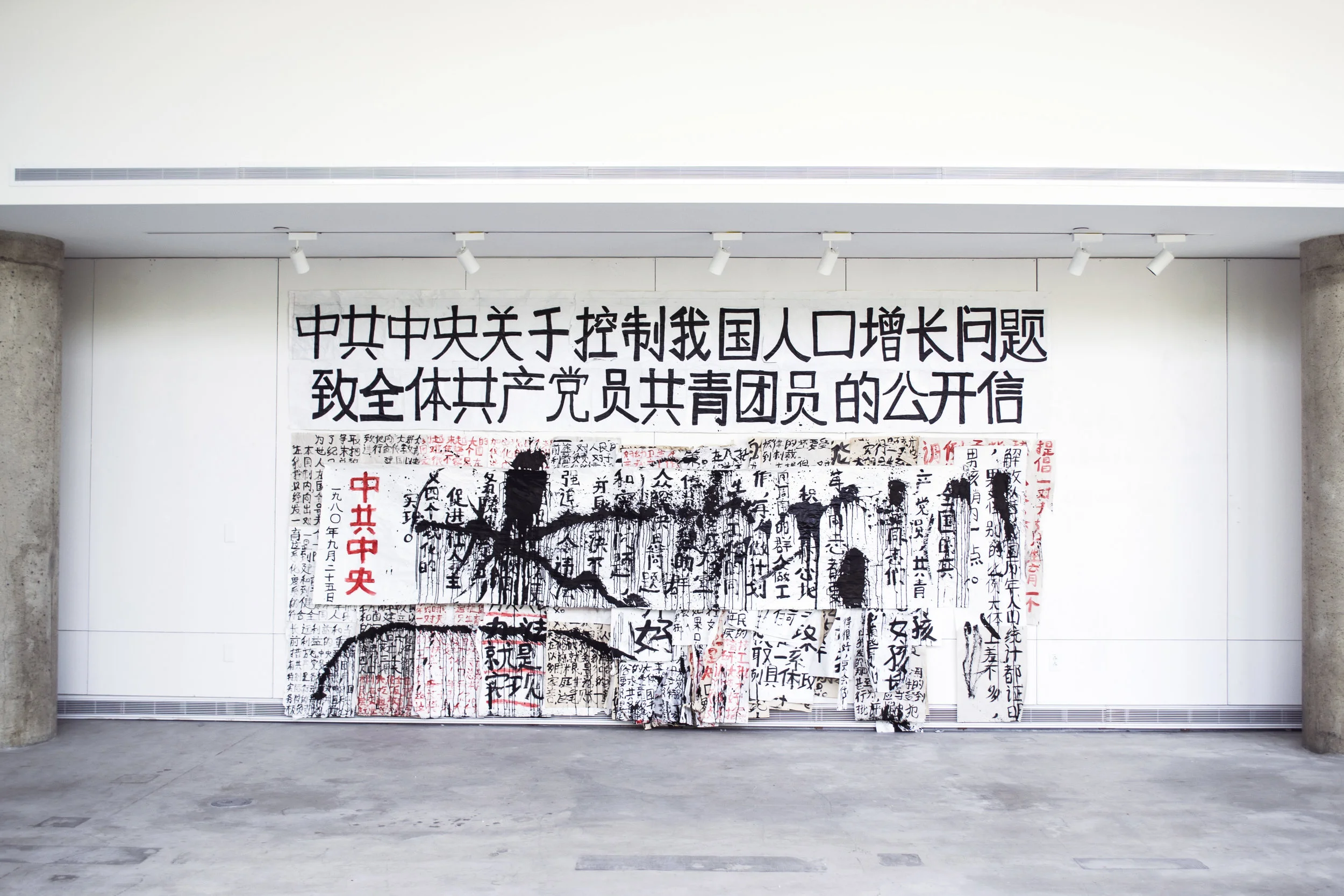
20'x8', acrylic and India ink on newsprint, 2017
This mural/painting/installation was the culmination of a month long studio intensive course. I went in to the class wanting to paint a self portrait in the style of Chinese propaganda posters. I came out with a super conceptual piece that moved me away from using imagery to using text.
"How I Feel About the One-Child Policy" is my interpretation of the letter written by the Central Committee of the Communist Party of China from 1980, which is in essence the letter that mandated the one-child policy. The piece is influenced by dàzìbào (大字报), or big character posters, traditional Chinese calligraphy, historical events, contemporary politics and is meant to be very political, loud, and most importantly, informed. It criticizes and challenges Communist China and is a statement on democracy and political progress.
There is a historical connection and meaning behind every single aspect of this piece. The mediums I used, the overall physical structure and design, every splatter and every tear, the style and format/direction of the characters, everything has an explanation.
Starting with the physical structure, I wanted the mural to look like an artifact ripped from history. What I imagined when constructing this piece was a wall--the Democracy Wall (1978-79) in Beijing to be specific, which holds great cultural significance in China and was home to countless dazibao posters. Like dazibao in real life, I layered the letter to mimic messages getting pasted on top of one another on urban walls. To add life and age I peeled some sheets and tore others. This was also an ode to the radical artists active during the Cultural Revolution who would tear and splatter paint on traditional calligraphy posters they were forced to print as a form of rebellion against Mao Zedong, who had appropriated the art form and turned it into a tool for communist propaganda. (Later on after his death it would once again be re-appropriated by the masses, coming to life as dazibao, as a key component of the democracy movement in China.)
The way I formatted the letter for reading is very significant. The piece moves in and out of modern to traditional forms, while also emulating the style of dazibao and making a statement on the cultural importance of calligraphy. As an outsider of Chinese culture, this played a very critical role in asserting and legitimizing my place in contemporary Chinese art. For native Chinese speakers, my goal was to play with their sense of time and grammar. The majority of the letter is formatted to be read from left to right, as typical documents go. As you move from left to right, however, at some point in the middle I changed the direction of the text to read right from left. The statement being made here was about the backwards nature of the letter. I wanted to visualize a country moving backwards in time when a one-child policy became the norm. By turning the letter into complete mayhem, using layers, tears, dramatic shifts in direction, I wanted to evoke what it must’ve been like living in Communist era China. I wanted native speakers to be confused and disoriented to comment on the historical ramifications and implications of the one-child policy in a historically patriarchal society that only became apparent years later when China realized its ratio of men to women was way off. To round the entire piece off, I wrote the very last paragraph of the letter in the most traditional form of Chinese calligraphy where it reads right to left, down and up. With this I wanted to say: I love you China, but this is why I had to make this piece.
Lastly, the giant splatters of ink that tie the painting together is an ode to the three students from Hunan (where I’m from) who threw eggs filled with black paint at the portrait of Mao in Tiananmen Square in 1989 during the protests.
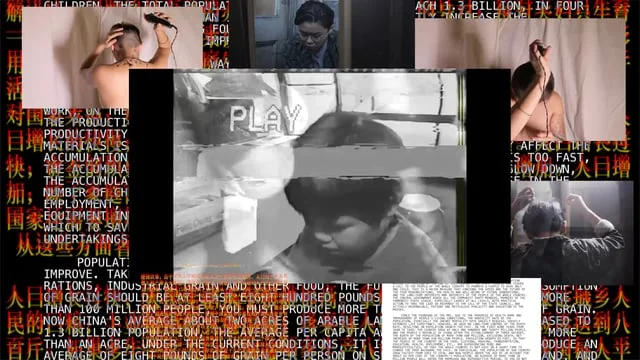
Intended for 15'x12' projection, mixed media, 2017
I use media art to explore representation and memory.
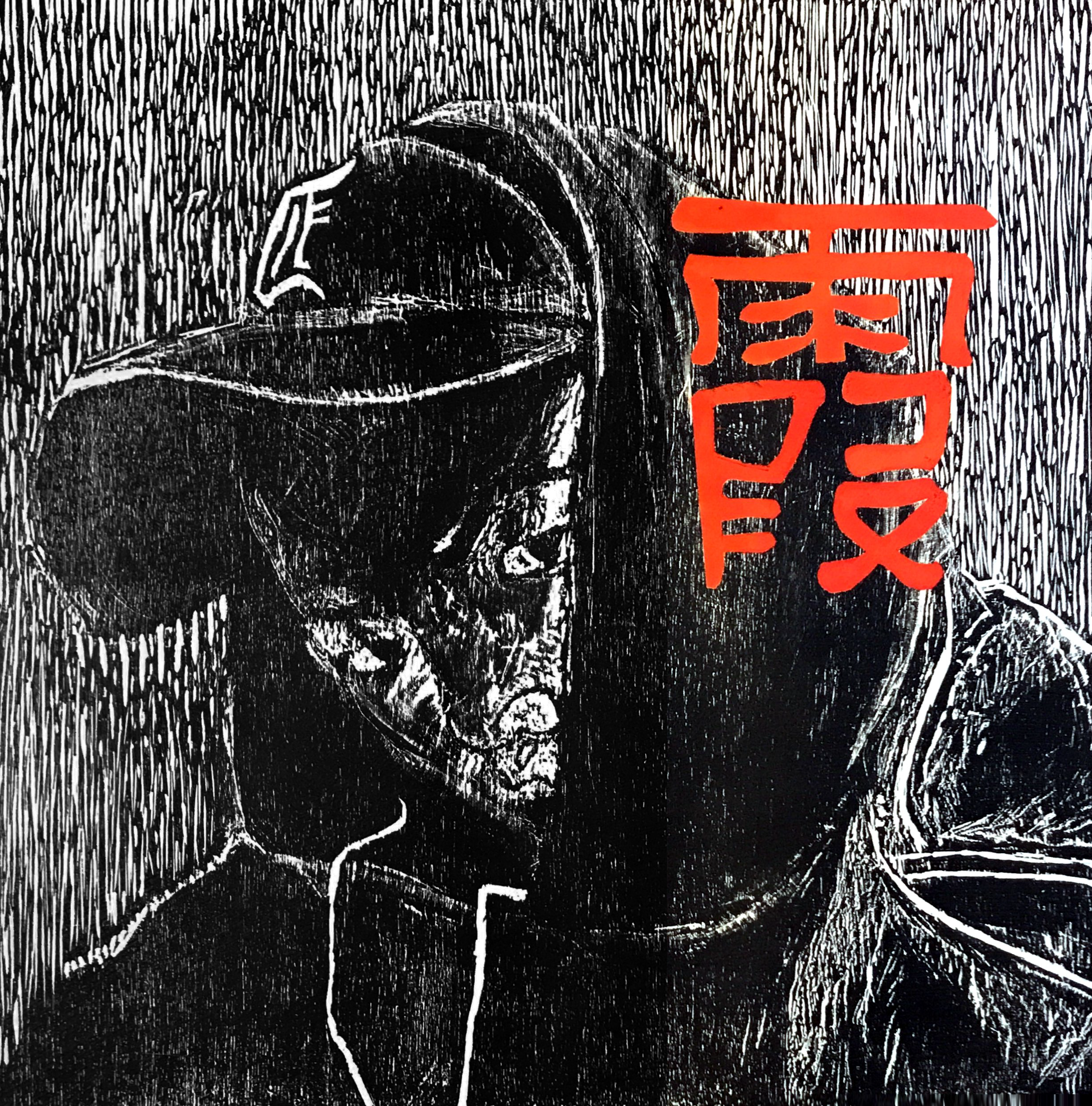
This video is an excerpt from the projected poem portion of my ongoing You Left Me Early project. For this central piece in particular I wanted to use text rather than picture to emphasize the power of words to seriously change the course of history and individual lives. The poem is broken into 2 parts in this video: "Naming" and "You Left Me Early". In "Part I: Naming", I introduce my name, Xia, which in Chinese means "dawn." Not only does this word suggest the time of day I was left by my birth family, it can also be interpreted as the time in my life--early.
In "Part II: You Left Me Early", I explore my relationship to the open letter written on September 25, 1980 by the Central Committee of the Communist Party of China, on controlling the population growth in China--the letter that essentially lead to the introduction of the one-child policy.
This video was first presented on a 15'x12' ft. screen, and is intended for large scale projections as it contributes to my goal of taking up space and ensuring my message to China is impossible to ignore.
Transcription of the poem:
PART I: NAMING
霞
(XIÁ): RED CLOUDS
霞
(XIÁ): DAWN
YOU LEFT ME EARLY
(XIÁ): DAWN
霞
PART II: YOU LEFT ME EARLY
YOU LEFT ME EARLY
BEFORE I COULD SPEAK
YOU LEFT
ME EARLY
BEFORE I COULD SPEAK
BEFORE I COULD SPEAK
BEFORE I COULD SPEAK
UNDERSTAND
WHY DID YOU HAVE TO GO
DID YOU HAVE TO GO?
??????????????????????
YOU LEFT ME EARLY
YOU LEFT ME EARLY
BEFORE WE COULD SPEAK
THE FOLLOWING IS AN OPEN
OPEN
LETTER FROM THE CENTAL COMMITTEE
OF THE COMMUNIST PARTY
OF CHINA
THE CENTRAL COMMITTEE OF THE COMMUNISR
PARTY OF CHINA
SEPTEMBER 25, 1980
x3
. . .
ON CONTROLLING THE POPULATION GROWTH
IN CHINA
IT WASN’T YOUR FAULT
[THE LETTER IN CHINESE/ENGLISH]
SEPTEMBER 25, 1980
IN CHINA
MARCH 2, 1994
IN CHINA
IT WASN’T YOUR FAULT
IT WASN’T OUR FAULT
I WAS BORN
PART III: PREDETERMINED WORTH
don’t tell them you’re a girl
but more importantly
don’t tell them you’re afraid
they want to believe that you are
but even if you are don’t let them take that from you
they already
took so much
PART IV: maude, i hope you found love
all the images of adoption i have
are colored early morning sky.
the elevator doors opened
and it looked like a horizon of babies.
rays of light radiating warmly like they do at the crack of dawn.
crawling towards us looking
for any human contact they could get.
if i was a puzzle they were my pieces.
if they were a puzzle i was their piece.
peace.
peace:
something that doesn’t
come easily when
the first memory you had of
love was it leaving
(but you will find it.)
(and it will find you.)
part v: to whom it may concern,
we weren’t missing.
we were here.
but not there.
(we were anywhere but there.)
but we were here.
we weren’t missing.
where were you?
it wasn’t your fault
we weren’t missing.
where are you?
it wasn’t your fault
we weren’t missing.
we are here
[end]
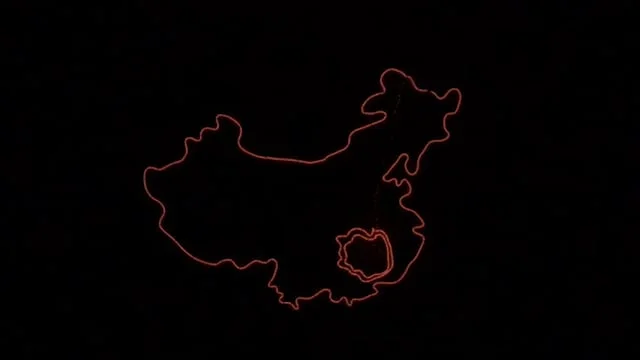
5'x3', neon LED lighting and foamcore, 2017
à la Nam June Paik.
12"x12", watercolor and relief ink on BFK Rives